


-
 Satisfaction Guaranteed.
-
 Secure Payments
- Refund policy
-
 Need help? Call Us 01744 520 110 or email sales@industrialsuppliesco.co.uk
Description
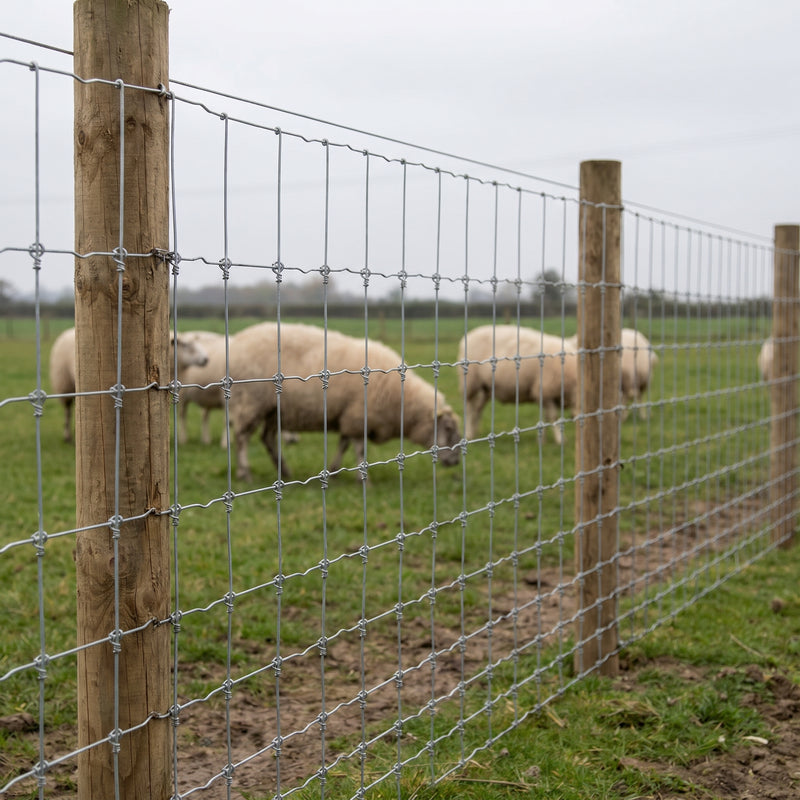
This C8/80/15 mild steel stock fencing is hinge joint netting for farmers, smallholders and fencing contractors who need to keep sheep, cattle and other livestock contained. It is the most commonly used mild steel stock fence, made in the UK and supplied on 50m or 100m rolls. The code tells you how it is built: C for the traditional woven hinge joint, 8 horizontal line wires, 80cm high, with vertical stay wires every 15cm. Mild steel does not need to be strained as tightly as high-tensile netting, and it follows gradual turns off intermediate posts, so it suits wandering boundaries, hedge-backed field lines and shorter runs.
Why it works
Mild steel that follows the fence line
Because mild steel netting does not need to be strained as tightly as high-tensile, the tensioning job is less demanding. You can also make gradual turns off intermediate posts rather than setting a straining post at every slight bend, which saves assemblies on a boundary with many turns. Backed by a hedge, it gives you a cost-effective barrier that is easy to install.
A hinge joint you can adapt
The hinge joint is the traditional woven joint for stock fencing. It is a cost-effective knot, and it can be cranked or turned out for special applications where a standard run will not quite fit.
Heavier wire at the edges, Class A coating
The top and bottom line wires are 3mm diameter; the intermediate line wires and vertical stays are 2.5mm. All wires have a tensile strength of 695-850 N/mm². The wire is galvanised to Class A under BS EN 10244-2. Coating mass and expected service life are not published for this line, so protect the coating during installation.
Where it's used
C8/80/15 is a general-purpose livestock fence. You will find it containing sheep, cattle and other livestock on farms and smallholdings, along forestry boundaries and around equestrian paddocks. It is a common choice for hedge-backed field boundaries, where the netting keeps stock in alongside the hedge. Its tolerance of turns makes it practical on irregular field edges and shorter runs between gateways.
Specifications
| Specification | Detail |
|---|---|
| Product | C8/80/15 mild steel hinge joint stock fencing |
| Country of manufacture | United Kingdom |
| Joint type | Hinge joint (C), traditional woven joint |
| Horizontal line wires | 8 |
| Height | 80cm (0.8m) |
| Vertical stay spacing | 15cm |
| Spacing between line wires | Not published for this line |
| Top and bottom line wires | 3mm, tensile 695-850 N/mm² |
| Intermediate line and stay wires | 2.5mm, tensile 695-850 N/mm² |
| Galvanising | Class A to BS EN 10244-2 |
| Coating mass | Not published for this line |
| Standards | BS EN 10218-2 (wire dimensions and tolerances); BS EN 10223-5 (woven hinged joint and knotted mesh fencing) |
| Roll lengths | 50m or 100m |
| Average roll weight | 50m: 32kg; 100m: 64kg |
Choosing the right option
This listing offers one specification in two roll lengths. Choose 50m rolls for shorter runs and easier handling; at around 32kg, a 50m roll is the more manageable to move into position by hand. Choose 100m rolls for longer runs, where fewer joins means less time tying in.
Be clear about where mild steel fits. High-tensile netting has largely replaced mild steel for long, straight runs because it holds tension with fewer posts, so for a long straight boundary it is usually the better buy. Mild steel earns its place on shorter runs, turning runs and hedge-backed boundaries. Two strands of barbed wire or a single electric wire can be added along the top.
Installation, use & care
Fit a straining post at every end and at every major change of direction, each supported by a strut or box assembly. Gradual turns can be taken off intermediate posts. Tie the netting off on the straining posts by hand or with suitable joiners. When tensioning, reduce the crimp in the netting by about 50%. Do not drive staples tight against the wire, as this damages the galvanised coating. Add barbed or electric wire along the top if required.
FAQ
Can I take the fence round bends without a straining post?
Gradual turns can be made off intermediate posts, which is one of the main reasons to choose mild steel on a boundary with many turns. Every major change of direction still needs a straining post supported by a strut or box assembly.
Is it suitable for a long, straight boundary?
It will do the job, but high-tensile netting has largely replaced mild steel for long, straight runs because it holds tension with fewer posts. Mild steel is the better fit for shorter runs, turning runs and hedge-backed boundaries.
Can I add barbed or electric wire?
Yes. Two strands of barbed wire or a single electric wire can be added along the top of the netting. Make sure your posts and straining assemblies are set up for the extra wire before you add it.
Ordering & delivery
Priced per roll as listed. Delivery is to UK mainland addresses. Rolls are heavy, averaging 32kg for 50m and 64kg for 100m, so they travel on a pallet or by kerbside service; plan for help or handling equipment on arrival. Your lead time is confirmed at checkout or on your order confirmation.
Our products have been used by
Logos are for illustrative purposes only and do not imply official endorsement







About Us
Suppliers to Ministry of Defence, NATO, US Airforce and Most UK Councils, Schools, Universities, Hospitals & various Government departments
Payment & Security
Your payment information is processed securely. We do not store credit card details nor have access to your credit card information.
